Wednesday, December 22, 2010
Christmas ? Trees
Istanbul is decorated with lots of Christmas trees. The city is responsible for the trees of white airy balls entwined with lights. In the foreground, a vendor is roasting chestnuts.
A high end shopping mall has a tree made of artificial poinsettias, with unwrapped packages from the mall shops underneath to maximize advertising.
A stationary store has plastic trees, stocking and ornaments for sale. All made in China.
And live Charlie Brown trees are now available for home use and subsequent planting. Many people will have a tree in their home, although the celebration here is really for New Year's, not Christmas. As it turns out, Santa comes here on New Year's Eve and delivers packages to the children. So if you thought Santa rested after Christmas, you are wrong. He's busy delivering to Turkey on New Year's Eve.
I picked up a Turkish copy of Charles Dickens "A Christmas Carol" (left) for my collector friend Nick. The shop also had an abridged version for younger children (right), the title of which has been changed to "A New Year's Day Story". The original ends with Tiny Tim saying, " God protect all of us, each one of us. Amen." and in the modified version, Tiny Tim says, "Have a merry and happy Christmas." I'll leave the rest of the translation comparisons to Nick.
Sunday, December 19, 2010
Polonezkoy
For my husband's niece's 29th birthday, several of us went to Polonezkoy (literal translation Polish Village) for brunch. Polonezkoy is to the east of where we live, away from the city, but still in the official city limits of Istanbul. We knew we arrived when we saw the sign welcoming us in three languages, Turkish, English and Polish. The Polish arrived in 1844, leaving their homeland, which was being absorbed into other empires.
Polonezkoy had become a little village with lots of good restaurants for those in Istanbul needing some fresh air to visit. We went to a restaurant and parked the car by the chicken and duck pen. I was hoping we were not eating fowl after seeing these creatures. The family owning/running this restaurant is the 5th generation from the 1844 exodus.
We dined in a private pavillion, which was surrounded by a garden filled with natural flora and kitch. We dined on bread and cheese, more bread and cheese, eggs and special jams. One soft white cheese reminded me of the cheese in Poland, and was more agreeable to my palate than the salty Turkish cheeses. We took home the leftovers.
Galata Tower, musical instruments
I was over in the Pera area of Istanbul for the International Women of Istanbul's Christmas luncheon, and afterwards, I took a walk to find the Galata Tower, which is a famous landmark in the Beyoglu section of Istanbul. This picture is taken from the Eminonu section of Istanbul, with the Galata Bridge over the Golden Horn in the foreground and the Galata Tower on the hill.
This was not my first time looking for the Galata Tower. The tower is not at the top of the hill, but down a bit. I took the narrow lane which is home to musical instrument shops. Modern day cymbals were invented in Istanbul in 1618 by an Armenian alchemist who was mixing copper, tin and silver to make gold. He did not get the gold result, but did get a metal with a nice sound to it, which impressed the sultan, who gave him the name Zildjian; zil being the Turkish word for cymbal. Zildian cymbals are still made today.
Turkey also claims the invention of kettle drums, and here, a pair from the Military Museum. Kettle drums were used by the military in the 17th to 19th centuries.
Anadolu Hisari Happenings
It's been a while since I last posted... I had a wonderful Thanksgiving with my family in NJ and returned to Istanbul after a short two weeks in the USA. The weather was still warm here (up to 70 degrees F) and I was happy to walk around outside. It takes me 45 minutes to walk to my local ferry landing and here are some of the sights along the way. On this walk, I noticed sheep grazing on the adjacent hill for the first time. I don't know if they are new neighbors, or old neighbors that I can now see with fallen leaves.
I stopped by an enclosed gravesite of Hasan Efendi and family, evidently people of importance to this area. Another walker asked me if I spoke German, and then told me that the dates on the marker were of the Arabic system, and were about 300 years old. Ottoman grave markers for men have carved turbans or hats, which depict their status or position in life. Markers for women have carved flowers and designs.
When I got to the Anadolu Hisari fortress, I saw a black pickup truck, which may be a common sight in the USA, but not here, and ...
upon closer look, was sporting a sticker from Cabela's in PA. Hunting is not legal in Turkey, nor ownership of guns, so this may be a one man political statement.
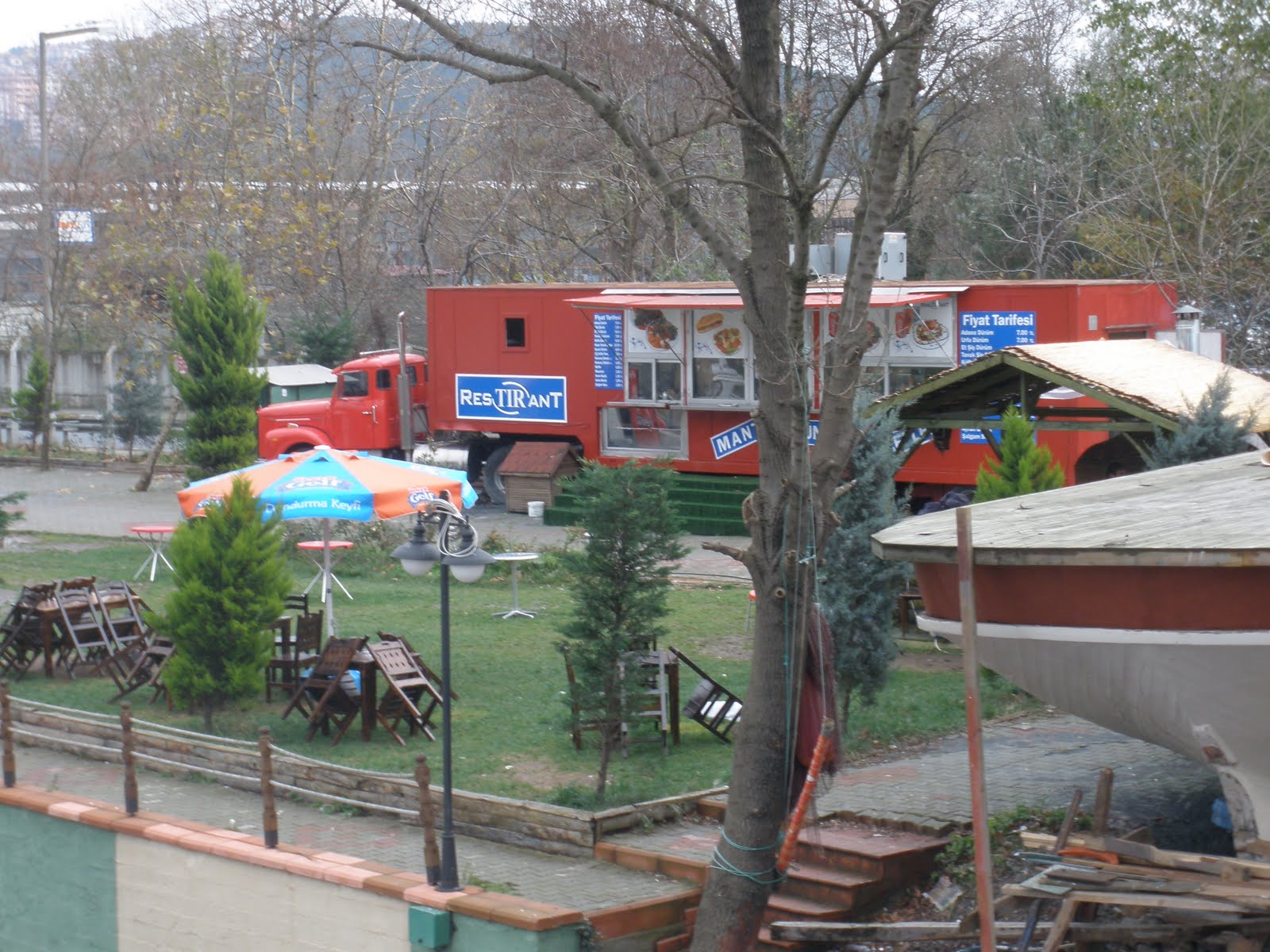
A new restaurant rolled into town, and it looks like it could just as easily roll out of town if we do not give it enough patronage.
By the ferry landing, a new home is being built. Homes along the Bosphorus can only be rebuilt to look like the traditional home that was there. Traditional homes are wooden, although I see vinyl siding in recent rebuilds. For this home, a wooden frame was started and is now being reinforced with steel. I would guess the steel is insurance for earthquakes. Homes along the Bosphorus are called yali and they go for many millions of dollars a piece.
Thursday, November 4, 2010
Ortakoy
Today's tour was to Ortakoy (middle village) on the European side of Istanbul. Ortakoy is well known for its most beautiful mosque, which sits at the edge of the Bosphorus. It was built in 1855 in the neo baroque style.
Within the area of a block around the mosque, is a church, and...

a synagogue. As buildings are packed tightly into a small space in Ortakoy, it was impossible to get two much less three of these buildings in the same picture. The church and the synagogue were both tightly locked up. The mosque was open, but I lacked the required long skirt and scarf to enter, so the insides of these buildings will remain a mystery.
Walking on the road parallel to the Bosphorus, you find the Kabatas Boy's School. The meaning is a bit deceiving, as the school is located in Ortakoy, not Kabatas, and since 1994, enrollment is open to girls as well as boys. The school was founded in 1908, is very prestigious high school, and I think, private.
Adjacent to the Kabatas Boy's School and in a deeper shade of yellow, is the Galatasary University. Both schools face the Bosphorus, and I don't know how any learning could take place in classrooms with such beautiful views. I, for one, would be staring out at the vessels traveling the Bosphorus day dreaming.
Now that you have seen the schools up close, you can try to find them in this picture taken from the mosque.
Last, but not least, I found the Simla Gallery in Ortakoy, which has an exhibit of Sabrina Fresko's jewelry, called "Sculptures to Wear". Sabrina's workshop is in the same building and she teaches all aspects of jewelry metalworking. Sabrina's jewelry will be on display at MOMA in New York City in May 2011, as part of their "discover Turkey" theme.
a synagogue. As buildings are packed tightly into a small space in Ortakoy, it was impossible to get two much less three of these buildings in the same picture. The church and the synagogue were both tightly locked up. The mosque was open, but I lacked the required long skirt and scarf to enter, so the insides of these buildings will remain a mystery.
Art Fair and Book Fair
Yesterday I ventured out to the annual Art Fair being held at the Tuyup Convention Center located at a far end of town. Over 100 galleries were represented with a wide range of art, primarily modern art by current artists. I did see a Dutch and an Italian gallery, the balance being Turkish. $4000 was the price tag on the paintings I was arracted to, but I made no purchase.
Running concurrently with the art fair is the book fair. Had I been in attendance earlier in the week, I may have seen the father and daughter pair, John and Maureen Freely,
who write about Istanbul and Turkey. Maureen also has translated recent novels of Orhan Pamuk and I hope she is busy working on his novel recently published in Turkish.
Most of the vendors at the book fair were selling academic text books for discounts between 20% and 40%. Bus loads of students were dropped off with lists of books to buy.
The USA also had a spot at the fair, with pamphlets on topics such as democracy, freedom and human rights. Your tax dollars at work!
The shuttle bus I took to the fair grounds was no where to be found when I was ready to head home. So I followed the masses to the public bus, which would take me to the Metrobus, which speeds along special lanes regardless of traffic volume. I was eager to try this Metrobus, to see if it might be a possibility for going to the airport. The student sitting next to me had also been to the book fair and one by one, opened up all her new books and smelt the print with her nose to the pages. She then read the beginning of each book and returned it to the bag. All the time with a big smile on her face - a happy reader!
Csontvary, Hungarian artist
Pecs, Hungary and Istanbul share the title of 2010 Capital of Culture. There have been many exchanges between museums of Europe and the museums of Istanbul. Currently, work of Hungarian artist Csontvary is on loan from the Pecs Museum to Istanbul's Pera Museum. Csontvary was born in 1853, educated as a pharmacist and at the age of 41, decided to pursue art. He travelled around Europe and the Middle East for lessons and then painting in oils.
His self portrait is used in the exhibit announcement on the front of the museum.
My favorite painting is titled " Roman Bridge in Mostar", painted in 1903. The painting description notes that the bridge was actually built by the Turks in the 16th century over the Neretva. Muslims lived on the left and Croatians on the right. The painting depicts the original bridge, which was destoyed in 1991 during the Yugoslavia war. Since then the bridge has been reconstructed with a Hungarian design and Turkish craftsmen.
Labels:
2010 Capital of Culture,
Csontvary,
Istanbul,
Pera Museum
Subscribe to:
Posts (Atom)