Thursday, February 9, 2012

Roman period glass

For glass lovers, Istanbul Archaeology Museum displays Roman period (30 BC - 395 AD) glass from excavations in Turkey, Cyprus, ...


Palestine and Syria.


Tuesday, February 7, 2012

Istanbul Archaeology Museum

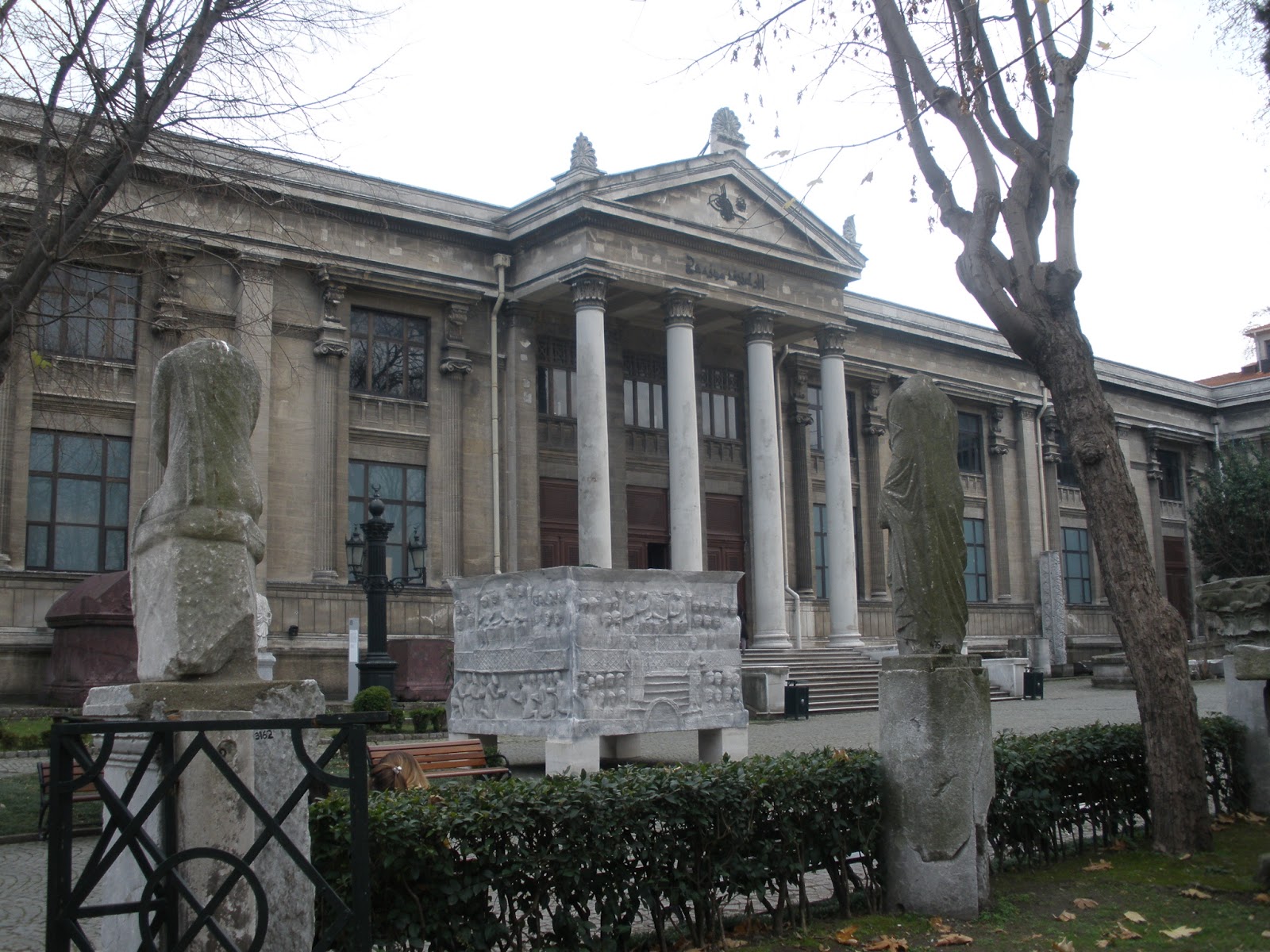
Istanbul Archaeology Museum was established in 1869 by Osman Hamdi Bey.  He directed the building of three buildings, which now are all exhibit space, as well as the surrounding garden.
The most ornate building houses the ceramic collection, including pieces...
made by the Seljuks, who inhabited Anatolia 10-13th century.
The main building houses artifacts excavated in the vast geography of the Ottoman empire.  
Small tablets displaying contracts are some of the oldest artifacts.  This clay tablet, about 2 inches by 2 and 1/2 inches is written in the Old Assyrian dialect from the 19th century B.C.   For those unable to translate your own, the contract states:
"Ahatutum bought the daughter of Hana and paid half-a-mina and 1 1/2 shekels of silver.  If Hana seizes her daughter, she will pay 1 mina of silver and take her daughter home.  If, someone else seizes her, then Hana will seize Ahatutum.  If, she makes improper things and behaves badly, she will sell her wherever she wishes.  Two witnesses"

So, how much money in today's currency, did Hana receive for her daughter?  To help with that problem, 1 mina weighs about 500 grams and 1 shekel weighs about 8 grams.
While you are working on that math problem, here are some bead molds, ...
and some beads, not made from the above molds.
The museum has so much to see, so for the balance of the pictures on this post, we have lions.  One in mosaic, ...
one from the Roman period (30 BC - 395 AD), ...
one of a pair from the Neo-Babylonian Nebuchadnezzar II period (604-562 BC), ...
Babalonian tiled lion, ...
and one portal lion from the Hittite period (8th century BC).
This is barely the tip of the iceberg, which is the Istanbul Archaeology Museum.  For glass lovers, a separate post of Roman period glass will be forthcoming.

At today's rate of precious silver, Hana would have received about $280 (USA) for her daughter.  For this nugget of history, we owe her so much more than that!

Divine Comedy by Dali in Tophane-i Amire

The literal translation of Tophane is "ball house".  Originally, part of the Imperial Armory, where the canons and canon balls were made, is Tophane-i Amire.  Today, the building is part of the Mimar Sinan Fine Arts University and the facility is used for art exhibits and functions supporting the school. 
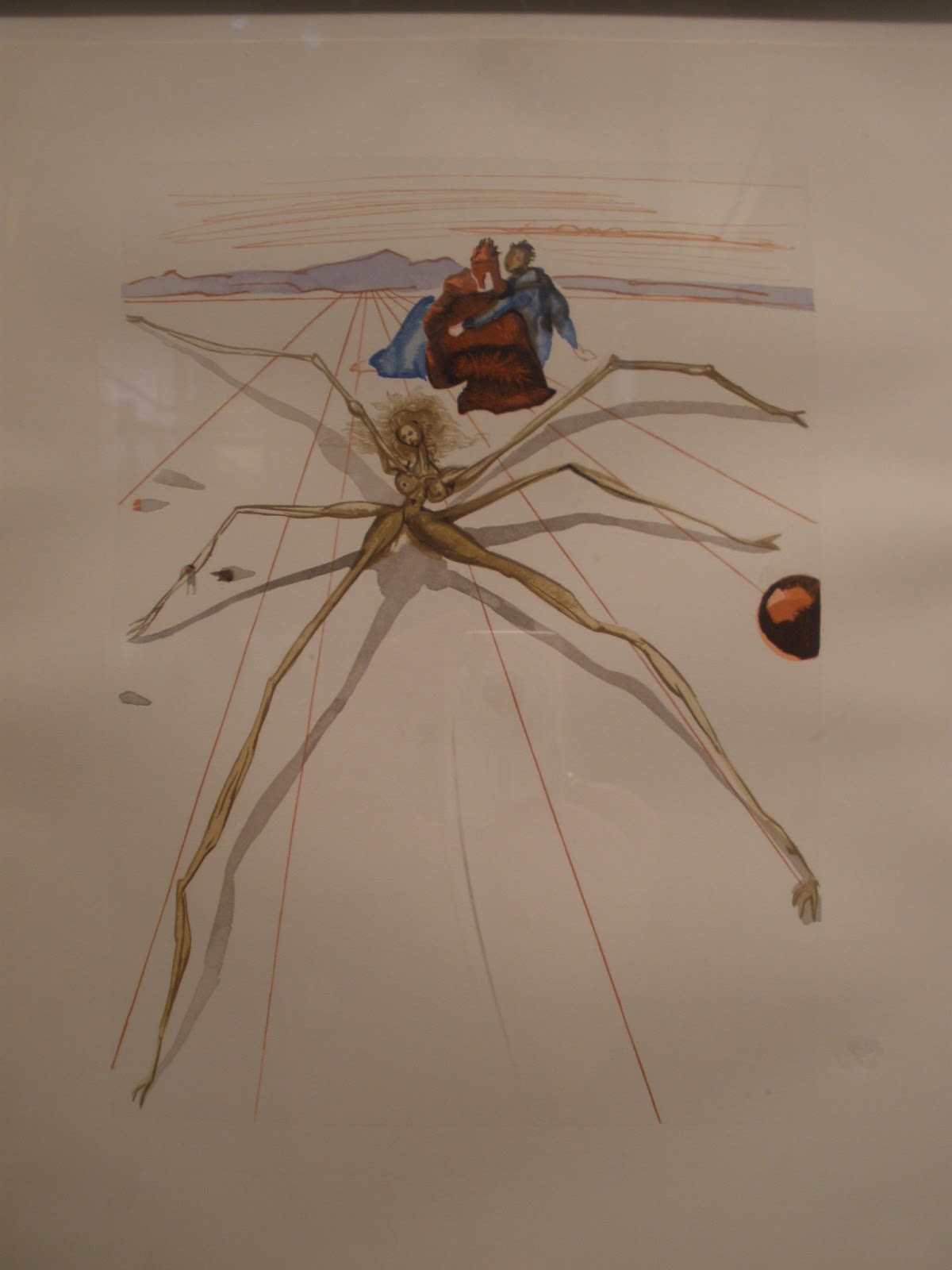
 Over 120 water colors painted by Salvador Dali and inspired by Dante's Divine Comedy are currently on display.
 Natural light shines in the space through hundreds of hexagonal windows.  You will see the reflection of these windows on the pictures of the paintings, which were framed under glass.  The exhibit was well attended, and we had good conversations with students from a school in Uskudar.
 The water colors were grouped in sections for the three locations in Dante's book - Inferno, Purgatory and Paradise.  You will have to guess which painting was in which section...
 Droopy clocks come mind when you hear Dali's name.  The same technique applies to faces.
 It might be too easy to guess which section the angels are in,...


For those interested in seeing the balance of the paintings in this collection, the exhibit is open until February 26, 2012.  Also, you can search the internet and find better quality photos than mine.

Saturday, December 17, 2011

Merry Christmas!

The Christmas decorations are looking quite a bit like last year's decorations, so I looked around for some that I had not seen last year.  The most creative tree goes to the Leonardo restaurant in Polonezkoy, who turned their chandelier into a decorated tree.
The candy shops are all nicely decorated for Christmas.  Here is one of the Divan shops, ...
 one of the Baylan shops made a tree out of their colored macaroons, ...
 and Cafer Erol has a red and white candy cane ring tree.  And the flavor is, ... no, not peppermint, but cherry!
Almost all of the trees are artificial, but I did find two very much alive trees at the Kanyon shopping center.  The girls inside even posed for me after giving treats from their red bag to children!
Have a very Merry Christmas!

Tuesday, December 6, 2011

a ferry ride

Just before heading out on my adventure for the day, I spotted a naval ship cruising down the Bosphorus.  You do not see naval ships very often.  After it was out of range, I left the apartment and took the bus to Anadolu Kavagi, the northernmost ferry stop on the Asian side.  My goal was to take the ferry from Anadolu Kavagi across the Bosphorus to Rumeli Kavagi.  This is the only Bosphorus ferry crossing that I had yet to take.  Temperatures today were forecast for the low 60's, so it seemed a good day for this excursion.
 While in Anadolu Kavagi, it was much easier to spot the castle at the top of the hill with the leaves off the trees.
 The ferry pushed off from the village of fish restaurants and fishing boats, ...
My Mom's house sold last week, and to celebrate, I brought my copy of her front door key with me and slipped it into the Bosphorus.  It can spend the rest of its life flowing back and forth between the Black Sea, just beyond the horizon line of this picture and the Sea of Marmara.
 Looking back to Anadolu Kavagi and the castle.
 And approaching Rumeli Kavagi on the European side of the Bosphorus.
 We were in about 50 feet of the ferry landing when an attendant on land shouted to us.  Evidently there were no passengers to get on the ferry, so we did not stop, but continued to the next stop, Sariyer.  That was fine with me.  I was heading there to see the exhibit of terra-cotta figures at the Sadberk Hanim museum.  No picture taking at that museum, but it is a very good one.
 After Sariyer, I bussed down to Yenikoy and after passing the cats on the pumpkin ledge, ferried back to Asia

Monday, December 5, 2011

Cengelkoy

Cengelkoy is a village on the Asian side of Istanbul.  The word "cengel" means "hook" and in this village, it represents the shape of the inlet along the Bosphorus.  

 Cengelkoy is located two villages to the north of the first bridge.  On a clear day you can easily see the outline of the historic section of old Istanbul.
 Smaller boats are harbored here, with experience needed for maneuvering the dock in the dark.
The most famous spot for tea in Cengelkoy, is under the sycamore tree.  An ancient tree with a huge trunk and supported limbs sits between a small mosque and the Bosphorus.
Team rivalries go back many years in Turkey.  In the Ottoman period, two teams competed in horsemanship - the cabbage men and the okra men.  A fountain in front of the police station shows the cabbage men support.
 Throughout Turkey, the very small Cengelkoy seedless cucumbers are the best.  I doubt many or any are grown in this congested village, but the name remains.
Cengelkoy also has a very nice bakery with their bread making processes displayed in ceramic on the store front.
 A few eateries offer the delicacy of kokorec, which is lamb intestine cooked on a rotisserie.   I have never tried it, so I cannot vouch for its taste.
 I can vouch for the almond meringue cookies, which are a tasty treat!
Thursday, December 1, 2011

If in Doubt, ...

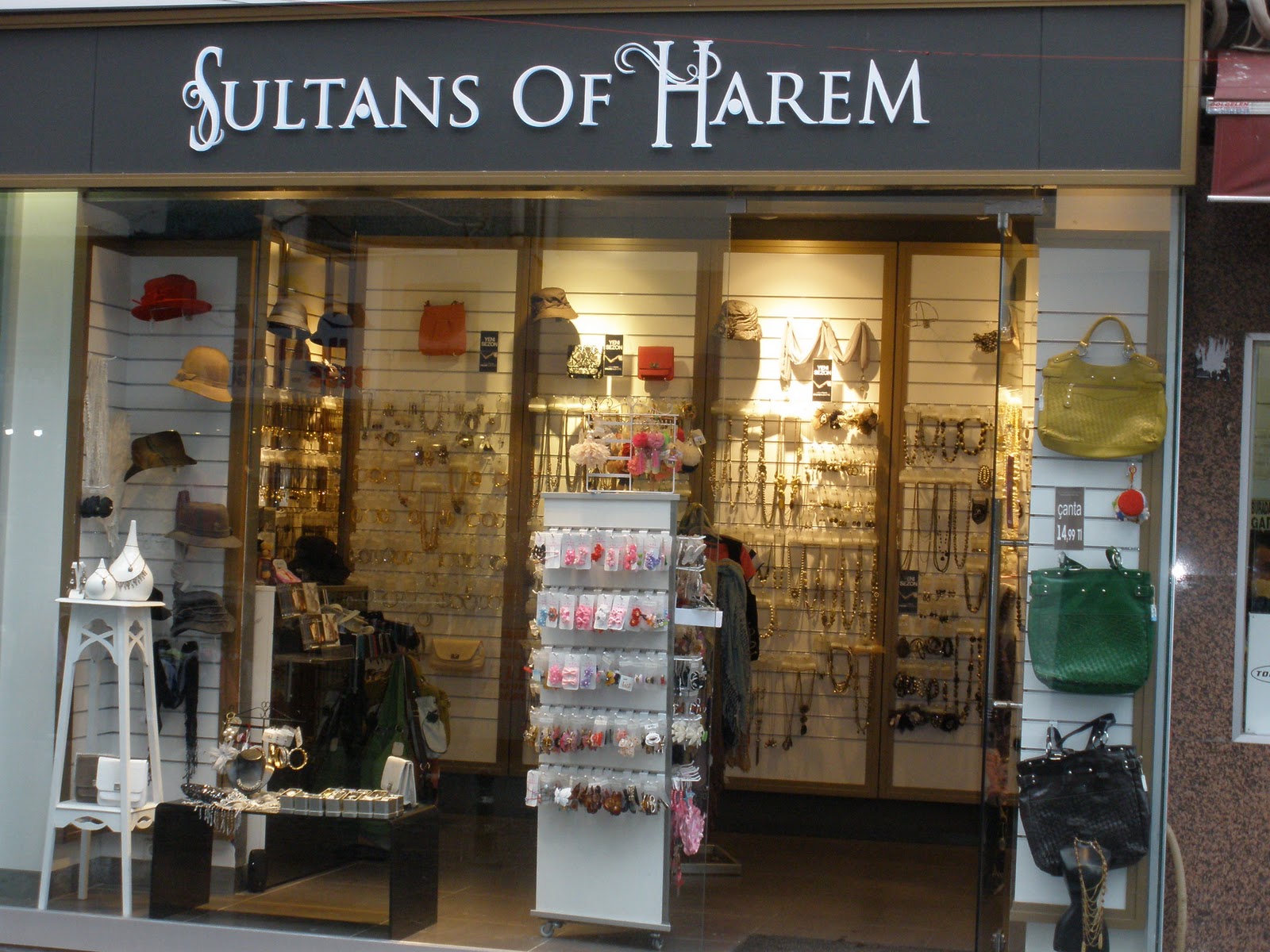
Accessorize!  My niece saw a small dish with this expression on it in a shop, but unfortunately, it was not for sale.  It was part of the display.  But it would have been perfect for my niece, who has a birthday today!  So in honor of her birthday and her interest in accessories, here are some shops in Istanbul that offer all sorts of accessories.


Accessories is not a Turkish word, so in hindsight, I am surprised so many use this word in their name.  Western influence infiltrating in this market area...
Happy Birthday, Kate!